

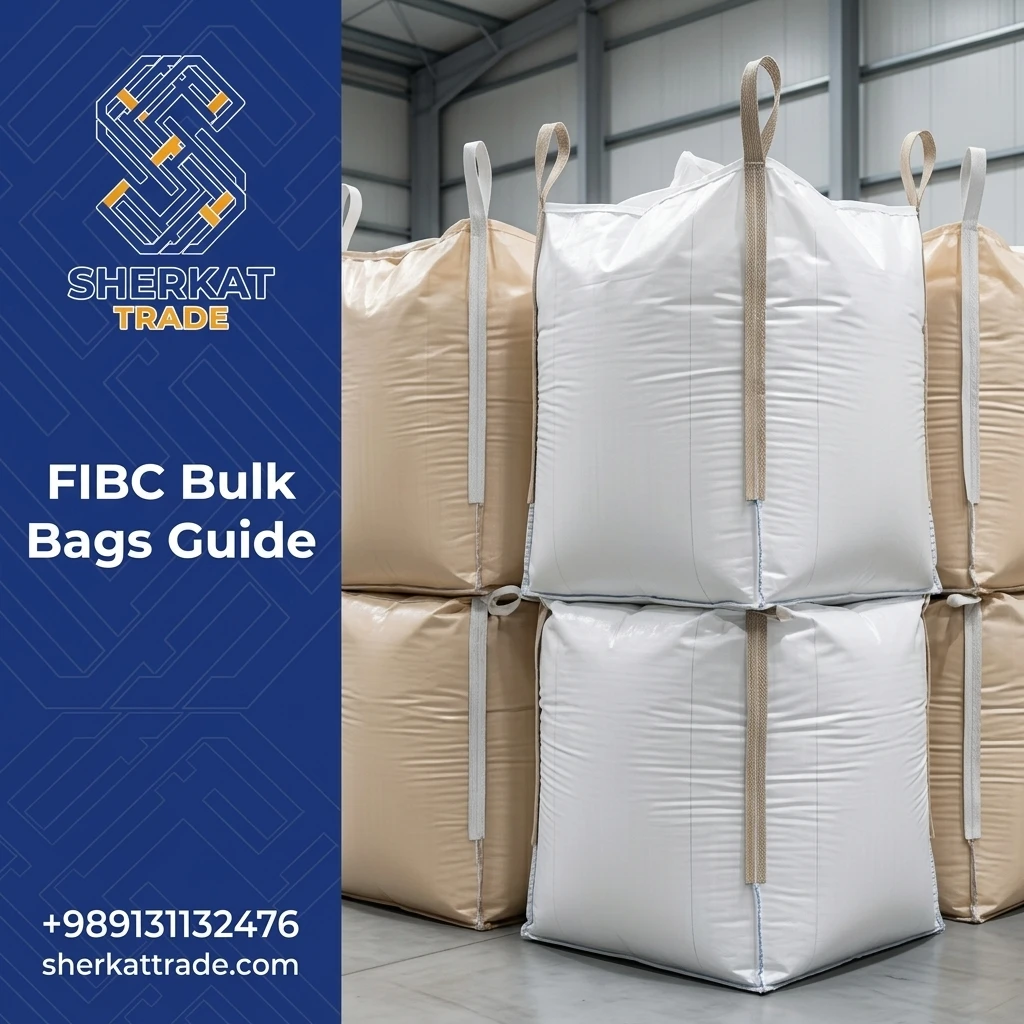
Flexible Intermediate Bulk Containers (FIBCs), universally identified within industrial logistics and materials handling as jumbo bags, bulk bags, or super sacks, represent an indispensable infrastructural component in the global transit, storage, and handling of dry, flowable commodities. Designed fundamentally from interwoven strands of oriented polypropylene (PP), these collapsible polymer receptacles have largely displaced traditional rigid intermediate bulk containers, multi-wall paper sacks, and fiberboard drums across agricultural, chemical, pharmaceutical, construction, and mineral supply chains. An industrial-grade FIBC is engineered to accommodate payload masses ranging from 500 kg to in excess of 2,500 kg, while maintaining an exceptionally low nominal tare weight of merely 2.3 to 3.2 kg. This yields an unprecedented strength-to-weight ratio that optimizes volumetric transport efficiency, reduces dead freight, and minimizes warehousing footprint when empty.
The transition toward high-capacity flexible polymer packaging has necessitated a profound evolution in global standardization, structural engineering, and material science. The mechanical integrity, electrostatic dissipation capacities, and environmental barrier performances of these containers are strictly governed by sophisticated international frameworks, most notably the comprehensive ISO 21898 standard for physical testing requirements and the IEC 61340-4-4 standards for triboelectric hazard mitigation. Modern FIBC deployment requires an intricate alignment of polymer chemistry, the fluid dynamics of bulk solids, and stringent regulatory compliance protocols. The ensuing analysis deconstructs the physical dimensions, architectural typologies, load-bearing physics, containment strategies, hazard mitigation techniques, and sustainability transitions that define contemporary FIBC applications.
Dimensional Engineering and Volumetric Analytics
The spatial footprint and dimensional architecture of an FIBC are not arbitrary; rather, they are meticulously calibrated to synchronize with the spatial constraints of global intermodal logistical infrastructure. Maximizing the internal volumetric capacity of a standard ISO shipping container or commercial flatbed trailer requires precise base dimensioning and rigorous height-to-width ratio management. The engineering challenge lies in reconciling the bulk density of the target particulate matter with the geometric limitations of pallets and transport vehicles.
The industry-standard footprint for U-Panel and Four-Panel FIBCs is 35 × 35 inches (approximately 90 × 90 cm), while seamless tubular designs typically default to a 36 × 36 inch (95 × 95 cm) base configuration. These dimensions are algorithmically derived to permit two units to be positioned side-by-side on standard global pallets—such as the 40 × 48 inch North American pallet or the 100 × 120 cm Euro pallet—and to efficiently utilize the standard 2.46-meter internal width of commercial transport trucks without exceeding lateral width tolerances. Standard manufacturing tolerances for these dimensions dictate an allowable variance of ± 2 cm for width, length, and height, alongside a ± 5% tolerance for overall fabric weight.
Internal vs. Outer Dimensions
A critical dynamic in dimensional engineering is the structural disparity between Internal Dimensions (ID) and Outer Dimensions (OD). Due to the inherent flexibility of the woven polymer matrix and the radial expansion of stitched seams under the hydrostatic-like outward pressure of bulk solids, the OD of an FIBC will invariably expand by 4 to 5 cm compared to its static ID under full load. Consequently, a bag specified with an external dimension of 95 × 95 cm possesses an internal packing footprint of approximately 91 × 91 cm. Failure to accurately account for this expansion margin frequently results in "pallet overhang," a condition that destabilizes the load, disrupts automated storage and retrieval systems (ASRS), and exacerbates friction-induced abrasions against adjacent bags during vehicular transit.
Height specifications generally range from 30 inches to 88 inches (76 cm to 223 cm), determined exclusively by the specific gravity and bulk density of the target material. To maintain mechanical stability during vertical lifting and multi-tiered stacking, rigorous engineering parameters dictate that the ratio of the filled bag's height to its width must never exceed 2:1. Exceeding this critical limit shifts the center of gravity dangerously upward, introducing a severe topple hazard during forklift acceleration, deceleration, or lateral transit maneuvers.
The calculation of precise volumetric capacity relies on the complex interplay between the physical dimensions of the container and the bulk density of the particulate matter. The foundational equation for estimating the theoretical capacity in cubic feet incorporates the dimensions adjusted for standard fabric bulging and material settling:
Capacity (lbs) = (L/12 × W/12 × H/12) × Bulk Density (lbs/ft³)
In operational practice, an operator must divide the target product weight by the material's bulk density to determine the required cubic volume, subsequently applying an 85% to 90% "fill factor" safety margin, as filling an FIBC to 100% geometric capacity compromises structural stability and safe handling. Materials with high bulk density—such as dry sand (1,600 kg/m³), gravel (1,522 kg/m³), or cement powder (1,500 kg/m³)—will reach the mechanical weight limit of the lifting loops long before the internal spatial volume is exhausted. Consequently, heavy minerals are packaged in shorter, squat bags (e.g., 110–130 cm heights) to prevent catastrophic structural overload. Conversely, low-density materials like whole kernel wheat (880 kg/m³), granulated sugar (880 kg/m³), or wood pellets (500 kg/m³) require extended vertical dimensions (frequently approaching 200 cm) to achieve optimal transport mass.
| Commodity Category | Typical Bulk Density (kg/m³) | Optimal FIBC Base (cm) | Typical Height (cm) | Standard Capacity (kg) |
|---|---|---|---|---|
| Sand / Cement / Minerals | 1,360 - 1,600 | 90 × 90 | 110 - 130 | 1,500 - 2,000 |
| Fertilizer / Chemical Resins | 960 - 1,200 | 95 × 95 | 140 - 160 | 1,000 - 1,500 |
| Grains / Rice / Sugar | 720 - 880 | 100 × 100 | 160 - 180 | 1,000 |
| Wood Pellets / Biomass | 500 - 700 | 110 × 110 | 180 - 200 | 500 - 750 |
Table 1: Influence of Material Bulk Density on FIBC Dimensional Specifications and Capacities.
Structural Morphologies and Construction Topologies
The structural topology of an FIBC fundamentally dictates its spatial behavior, load distribution profile, and handling efficiency. Because flowable solids exert complex multidirectional lateral and downward pressures, the geometry of the woven panels must be engineered to prevent catastrophic seam failure while simultaneously optimizing warehouse footprint density. The selection of a specific construction type alters the stress pathways transmitted through the polymer fabric during mechanical suspension.
○ Circular (Tubular) Construction
The Circular or Tubular construction utilizes a continuous tube of woven polypropylene manufactured on an industrial circular loom. Because this design lacks vertical seams along the primary body, internal hoop stress is distributed uniformly across the entire woven polymer matrix, effectively neutralizing the weak points traditionally introduced by needle perforations. The fabric is merely stitched at the top and base. While this seamless nature affords exceptional tear resistance and is highly economical, the absence of rigid corners causes the filled container to adopt a cylindrical or barrel-like profile. Consequently, circular bags are predominantly deployed for low-cost, free-flowing materials—such as agricultural fertilizers or raw aggregates.
∪ U-Panel Architecture
U-Panel designs are fabricated from three primary fabric components: a single continuous length of high-strength fabric that constitutes the base and two opposing lateral walls (forming a "U" shape), with two additional side panels stitched into the resulting configuration. This continuous under-sling architecture ensures that gravitational forces generated during top-lifting are channeled directly from the base through the contiguous vertical walls, bypassing bottom seam stress. The U-Panel naturally maintains a more orthogonal, square geometry than circular alternatives, improving multi-tier stacking stability.
⚃ Four-Panel Architecture
Four-Panel architectures represent the pinnacle of external shape retention among standard, non-baffled bags. Constructed from four independent vertical panels stitched to an isolated base panel, these bags exhibit superior dimensional rigidity, maintaining a strict cubic profile that is essential for dense palletization and intermodal containerization. This configuration maximizes space efficiency but demands extensive linear stitching. Consequently, it possesses the greatest surface area susceptible to localized seam failure or fine-powder sifting under dynamic transit vibrations.
☒ Baffled (Q-Bag) Engineering
To actively counteract the inherent outward bulging of flexible fabrics under hydraulic-like powder pressure, the Baffle (or Q-Bag) topology introduces internal structural elements. Baffled designs optimize spatial utilization, recovering up to 20% to 25% of lost volumetric capacity inside standard shipping containers by rigidly eliminating lateral bellying.
- Four-Corner Baffles: Restraining outer walls for a near-perfect cube.
- Full-Panel Baffles: Highest dimensional stability for tight container loads.
- Ventilated Baffles: Breathable panels for agricultural produce.
- Box/Q Baffles: Rigid boxed corners locking the shape in place.
Conical and Specialized Constructions
Beyond standard cubic forms, Conical FIBCs feature a severely tapered, funnel-like bottom, engineered specifically to facilitate the rapid and complete discharge of materials with high angles of repose. This geometry is essential for cohesive products, sticky powders, and hygroscopic substances—such as certain food ingredients or chemical resins—that would otherwise bridge or rat-hole during standard flat-bottom emptying operations.
Comprehensive Guide to FIBC Bulk Bags: Specifications & Engineering
Comprehensive Guide to FIBC Bulk Bags: Specifications & Engineering
Fabric Mechanics: Grammage, Safe Working Loads, and Safety Factors
The formidable load-bearing capability of an FIBC is fundamentally derived from the micromolecular orientation of its polymer components. During the initial manufacturing phases, extruded polypropylene (PP) films are longitudinally drawn and stretched to align the polymer chains. This orientation process dramatically increases the tensile strength-to-weight ratio of the resulting tape yarns before they are wound onto bobbins and fed into industrial looms. The density and robustness of this resulting woven matrix are measured in Grams per Square Meter (GSM), which serves as the primary technical metric for the fabric's mechanical resilience.
Standard FIBCs utilize fabrics ranging from roughly 120 GSM for light agricultural duties to upwards of 280 GSM for extreme mineral transport and severe industrial environments. The calculation of the required GSM involves integrating the target load capacity, the mandated safety factor, and environmental treatments into a cohesive formula. For instance, an FIBC engineered to safely transport 1,000 kg typically requires a base fabric of 160 to 200 GSM. If moisture resistance or superior dust containment is required, an extruded polypropylene lamination layer (coating) is thermally applied to the fabric, adding approximately 15 to 30 GSM to the total weight. It is critical to note from an engineering standpoint that while this lamination increases total GSM and provides a formidable environmental barrier, it contributes negligible tensile strength to the bag's lifting architecture.
Safe Working Load (SWL) and Safety Factor (SF)
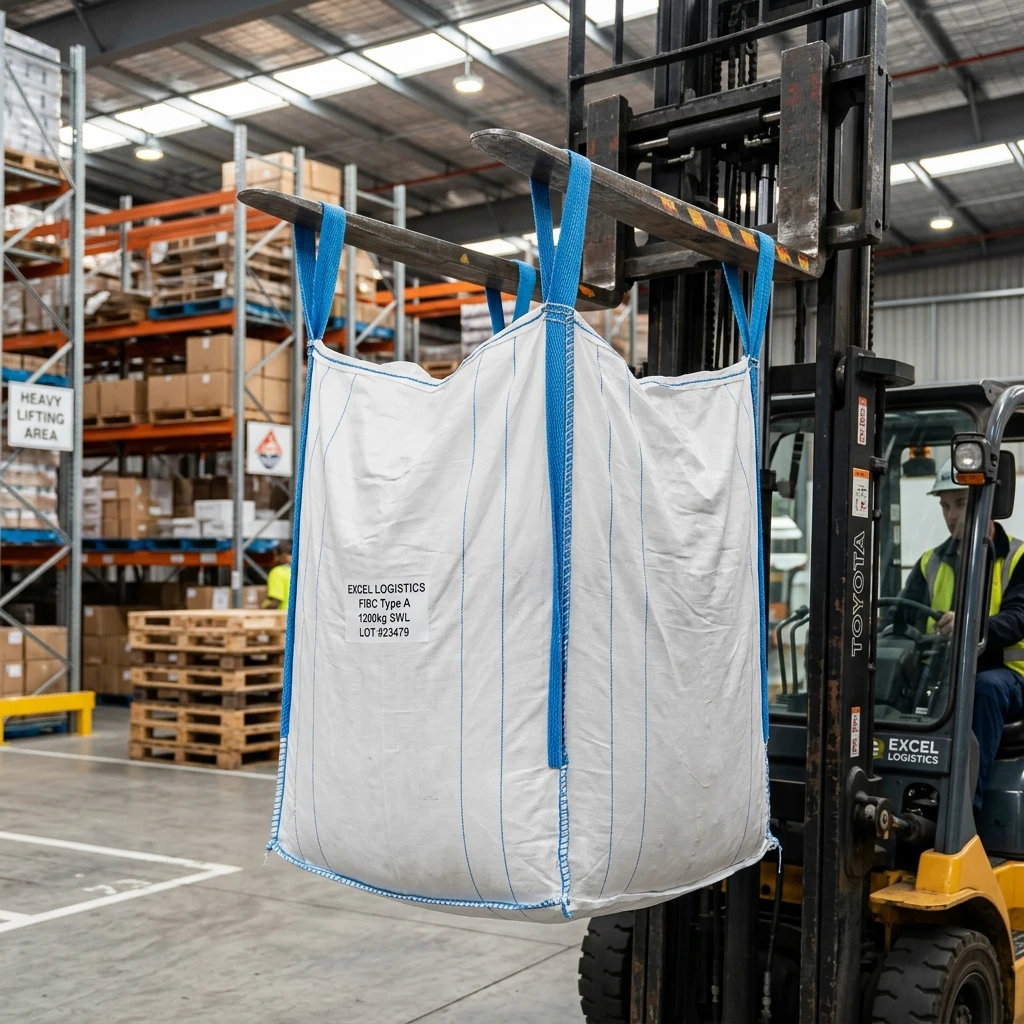
The operational envelope of an FIBC is defined by two universally recognized, interlocking metrics: the Safe Working Load (SWL) and the Safety Factor (SF). The SWL is the certified maximum mass the container is authorized to lift during standard logistical operations—typically specified at 1,000 kg, 1,500 kg, or 2,000 kg. However, the SWL is merely the visible, operational threshold. The actual structural reality of the container is dictated by its Safety Factor, which represents the mathematical ratio between the bag's ultimate breaking strength under laboratory testing conditions and its stated SWL.
| Safety Factor (SF) | ISO 21898 Designation | Ultimate Test Strength (for 1,000 kg SWL) | Operational Profile |
|---|---|---|---|
| 5:1 | Single-Trip | 5,000 kg | One-way transit, non-hazardous goods, disposable. |
| 6:1 | Standard-Duty Reusable | 6,000 kg | Multi-trip closed loops, hazardous materials, high-stress handling. |
| 8:1 | Heavy-Duty Reusable | 8,000 kg | Extreme frequency handling, severe industrial environments. |
Table 2: Safety Factor Designations and Associated Load Mechanics.
The mechanical distinction between a 5:1 and 6:1 Safety Factor is far more profound than a simple 1,000 kg increase in static breaking strength. In real-world environments, dynamic lifting—such as the sudden vertical acceleration of a forklift tine, the abrupt deceleration of a winch, or the bouncing of a suspended bag during crane traverse—multiplies the gravitational force exerted on the lifting loops by a factor of 2 to 3. A 5:1 FIBC possesses adequate structural margin to absorb these kinetic shocks for a single operational lifecycle (comprising filling, transport, and discharge) without catastrophic failure.
For a bag to be rated at a 6:1 SF and certified for multi-trip use, the ISO 21898 standard dictates brutal, sustained cyclic testing. A 6:1 FIBC must survive 70 consecutive top-lift cycles applying 4 times the SWL, followed immediately by a final peak load test at 6 times the SWL. By comparison, a heavy-duty 8:1 FIBC undergoes 70 cycles at 6 times the SWL, terminating with a peak test at 8 times the SWL. The integration of a 6:1 or 8:1 SF is therefore not merely an arbitrary precaution; it is an absolute mechanical necessity for mitigating the accumulative strain, loop wear, and polymer fatigue inherent in returnable packaging programs and reverse-logistics supply chains.
Containment Integrity: Seam Architecture and Sift-Proofing Strategies
While the woven polymer matrix of an FIBC provides formidable tensile strength, it is inherently permeable. Micro-gaps naturally exist between the overlapping warp and weft tapes, which are compounded by the mechanical perforations created by industrial sewing needles during assembly. For granular products like pellets, standard seams are sufficient; however, for highly refined materials, these microscopic gaps act as escape highways. Under normal transport vibrations, the hydrostatic-like pressure of fine powders forces material through standard stitch channels, resulting in product loss, workplace contamination, and potential safety hazards.
Achieving hermetic containment and preventing product migration relies on the implementation of advanced sift-proofing (or dust-proof) engineered seams:
Fold-over Seams
The fabric edge is folded before sewing, slightly reducing direct pathways for migration but lacking true hermetic sealing properties, suitable only for moderately dusty granules.
Single-Sided Sift-Proof Cords
A "filler cord"—a fluffy, highly compressible yarn made of crimped polypropylene—is inserted along one side of the stitch line. As the industrial needle punches through the fabric, the expanded filler cord rapidly compresses, instantly expanding to seal the microscopic puncture voids left by the needle and thread.
Double-Sided Sift-Proof Cords
Filler cords are stitched on both the interior and exterior sides of the seam, deployed heavily in the packaging of flour, processed grains, and finely milled quartz sand.
Triple-Sided Seams with Felt
The most rigorous woven defense mechanism. This configuration stitches dustproof cords on both sides and inserts an additional layer of non-woven PP felt directly between the overlapping fabric panels. This completely obstructs the powder's path, utilized when FIBCs are filled under high pressure with ultra-fine, highly volatile materials such as powdered milk, calcium carbonate, lime, and starches.
Taped/Seam-Sealed Architecture
For supreme pharmaceutical or chemical containment, thermodynamic seam-seal tapes are bonded over the entire length of the stitching post-assembly, entirely isolating the needle pathway and creating an impenetrable barrier against both outward dust migration and inward moisture intrusion.
Atmospheric Barriers: Advanced Polymeric Inner Liners
When absolute atmospheric control is required to protect valuable commodities from oxygen degradation, moisture vapor transmission, or ultraviolet spoilage, an FIBC must be fitted with an independent inner liner. Liners range from basic tubular polyethylene cylinders—which offer straightforward moisture protection but can bunch or bridge during discharge—to advanced form-fit designs. Form-fit liners are engineered to perfectly mirror the FIBC's orthogonal geometry, incorporating identical spout diameters and lengths, which prevents fabric folds, enhances filling speeds, and ensures complete product discharge without residual heel trapping.
EVOH (Ethylene Vinyl Alcohol) Liners
Produced in highly sophisticated 5-to-7 layer co-extruded constructions, EVOH barrier liners provide unparalleled resistance to oxygen and water-vapor transmission. These are critical in the food and beverage sectors, extending the shelf life of highly oxidative products such as coffee, dairy powders, chocolates, and high-value seeds.
Polyamide (PA) Liners
Characterized by exceptional rigidity, puncture resistance, and thermal resilience, PA liners are specifically deployed in environments requiring the direct hot-filling of industrial products—such as liquid chemicals or molten resins—at extreme temperatures up to 170°C.
Aluminum Laminated Liners
Combining aluminum foils with polymer compounds, these liners achieve maximum impermeability against O2, H2O, and light, while serving as the ultimate odor barrier. They are specifically mandated for highly hygroscopic chemical precursors and sensitive pharmaceutical ingredients.
Comprehensive Guide to FIBC Bulk Bags: Specifications & Engineering
Comprehensive Guide to FIBC Bulk Bags: Specifications & Engineering
Triboelectric Hazard Mitigation and IEC Electrostatic Classifications
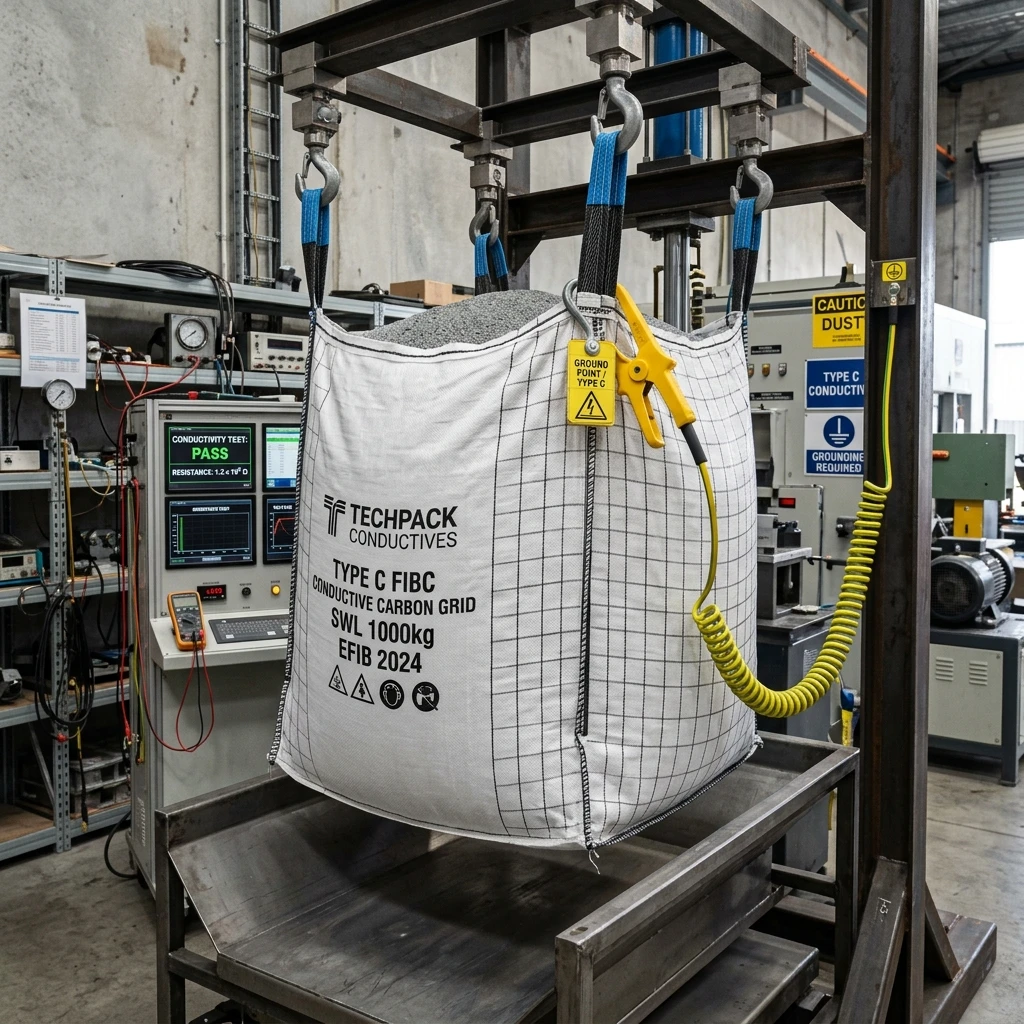
The transportation and handling of dry powders inside highly insulating polymer containers generates immense quantities of static electricity via triboelectric charging. As particulate matter flows into or out of an FIBC, the intense frictional interaction between the granules and the polypropylene walls physically strips electrons, creating highly localized, immense capacitive charges on the bag's surface. In industrial environments containing combustible dusts (such as flour or coal powder) or volatile solvent vapors, the sudden, unmitigated discharge of this accumulated electrostatic energy can ignite the atmosphere, leading to catastrophic deflagrations.
To rigorously manage this thermodynamic risk, the International Electrotechnical Commission (IEC) standard 61340-4-4 establishes stringent testing protocols and classifies FIBCs into four distinct categories based on their electrostatic dissipation properties.
| FIBC Category | Static Control Mechanism | Required Electrical Property | Earth Grounding Required | Safe for Flammable Vapors |
|---|---|---|---|---|
| Type A | Insulating | Surface Resistivity > 1012 Ω | No | No |
| Type B | Anti-propagating | Breakdown voltage < 6 kV | No | No (Only for Dust MIE > 3mJ) |
| Type C | Conductive network | Resistance to ground < 108 Ω | Yes (Mandatory) | Yes (Strictly if grounded) |
| Type D | Dissipative fabric | Corona discharge generation | No | Yes (If uncontaminated) |
Table 3: Electrostatic Classifications and Capabilities per IEC 61340-4-4.
Inner Liner Compatibility Matrix (IEC 60079-32-1)
Crucially, the integration of polymeric inner liners into electrostatically rated FIBCs requires strict compatibility monitoring, explicitly defined by IEC 60079-32-1. Inner liners are classified into three static profiles:
| Inner Liner Designation | Surface Resistivity Limit | Permissible in Type B | Permissible in Type C | Permissible in Type D |
|---|---|---|---|---|
| Type L1 | < 107 Ω | No | Yes | No |
| Type L2 | 109 to 1012 Ω | Yes | Yes | Yes |
| Type L3 | > 1012 Ω | Yes | No | No |
Table 4: Electrostatic FIBC and Inner Liner Compatibility Matrix per IEC standards.
Hazardous Material Transport and UN Certification Protocols
The cross-border movement of dangerous goods—such as toxic chemical intermediates, highly reactive mineral compounds, corrosive powders, and severe oxidizing agents—transcends standard ISO 21898 guidelines. These operations fall under the stringent, non-negotiable mandates of the United Nations Model Regulations for the Transport of Dangerous Goods. FIBCs intended for such perilous applications must undergo rigorous, destructive third-party physical testing at authorized laboratories to attain a UN Certification mark.
UN Material Designations (Code "13")
- 13H1: Woven plastic construction (PP), uncoated, without an inner liner.
- 13H2: Woven plastic construction, continuously coated, without an inner liner.
- 13H3: Woven plastic construction, uncoated, equipped with a separate inner liner.
- 13H4: Woven plastic construction, continuously coated, equipped with a separate inner liner.
Brutal Physical Testing Matrices
- Drop Test: A fully loaded bag is hoisted and dropped from up to 1.8 meters onto a rigid surface without rupturing base seams.
- Topple Test: The FIBC is tipped over from a designated height to assess lateral seam burst limits.
- Righting Test: A deeply fallen, toppled container is lifted from a prone position via one or two loops to test asymmetric shear strength.
- Stacking Test: A prolonged static endurance test holding a top-load equivalent to maximum stack height for 24 hours at 40°C.
- Tear Test: A standardized puncture is made, and load is applied to ensure resistance to catastrophic tear propagation.
Weathering, Degradation, and the ISO 21898:2024 Revisions
Because standard FIBCs are composed entirely of hydrocarbon-based polypropylene, they are extraordinarily susceptible to photo-oxidative degradation. Prolonged exposure to ultraviolet (UV) radiation rapidly breaks the polymer chains, severely degrading tensile strength and turning the container dangerously brittle. To counteract this vulnerability, highly specialized UV-absorbing chemical stabilizers (often Hindered Amine Light Stabilizers, or HALS) and antioxidants are blended directly into the base resin.
The 2024 ISO 21898 Modernization
The ISO 21898 framework underwent a significant revision in 2024 to eliminate testing ambiguities and address evolving global outdoor storage requirements. The standard now explicitly mandates a 300-hour cyclic weathering test (alternating between 8 hours of intense UV irradiation at 60°C and 4 hours of condensation exposure at 50°C), after which the fabric must retain a minimum of 50% of its original breaking strength.
More profoundly, a new normative annex specifically addressing "Long-Term Outside Storage" requires an exhausting 1,500-hour UV exposure cycle. This regulatory evolution reflects a critical macro-shift: transitioning the product from being viewed solely as a transient logistical vessel to functioning as a semi-permanent environmental containment structure.
Comprehensive Guide to FIBC Bulk Bags: Specifications & Engineering
Comprehensive Guide to FIBC Bulk Bags: Specifications & Engineering
Environmental Sustainability and Recycled Polypropylene (rPP)
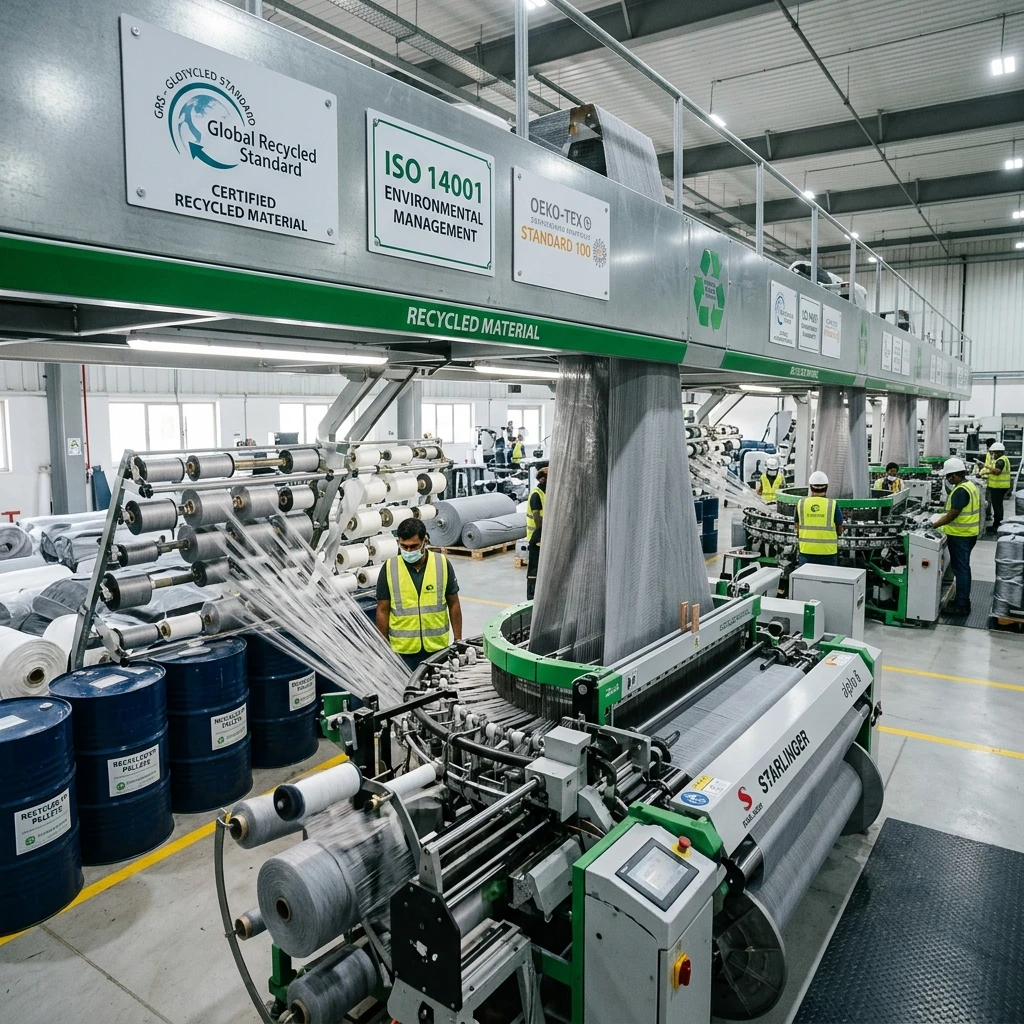
As the global packaging industry confronts mounting environmental pressure, FIBC manufacturing is transitioning toward highly monitored circular material architectures. This shift is accelerated by sweeping legislative actions, such as the UK Plastic Packaging Tax and EU Corporate Sustainability Reporting Directives, which levy substantial financial penalties on industrial plastic packaging failing to incorporate a minimum of 30% post-consumer recycled (PCR) polymer by weight.
However, incorporating 30% rPP into highly stressed, dynamic load-bearing structures presents severe material science challenges. Unlike virgin polypropylene, mechanically recycled feedstocks contain trace inorganic contaminants and varying molecular chain lengths. When drawn into microscopic tapes, these structural imperfections act as stress concentrators that can reduce burst resistance and elongation-at-break performance.
To achieve rigorous standard safety factors (like the mandatory 5:1 breaking threshold) while heavily utilizing recycled content, engineers must rely on advanced polymer blending technologies, modernized optical sorting facilities, and reinforced weave geometries. Quality verification within this circular economy requires entirely new certification regimes (such as European QA-CER) to ensure end-to-end traceability of the rPP supply chain and conformity to ISO 21898 safety expectations.
Conclusion
The structural engineering, deployment, and lifecycle management of Flexible Intermediate Bulk Containers entail a highly sophisticated convergence of woven structural geometry, polymer mechanics, fluid dynamics, and rigid international regulatory compliance. As global supply chains continually seek to maximize volumetric efficiency and reduce packaging tare weights, the specification of an FIBC must be precisely mapped against the bulk density and behavioral physics of the intended payload. The critical operational distinctions between safety factors, strict adherence to specialized electrostatic frameworks (IEC 61340-4-4), and UN dangerous goods transport guidelines ensure the absolute mitigation of catastrophic failures. As legislative evolution pushes the industry toward extreme 1,500-hour UV endurance requirements and the mandatory integration of 30% recycled material compositions, FIBC architecture is poised to remain at the forefront of bulk logistics.