

The Paradigm of the Payload Trap in Heavy Industrial Freight
The fundamental architecture of global supply chain logistics is dictated by a rigid mechanical dichotomy: the volumetric capacity of a cargo transport unit versus its absolute mass tolerance. Industrial shippers, procurement teams, and commodity buyers frequently succumb to a systemic logistical failure known throughout the industry as the "payload trap".
This critical error occurs when freight planning is optimized exclusively around internal spatial dimensions—typically measured in cubic meters (CBM)—while entirely neglecting the binding constraints of localized point-loading, material density, and maximum legal payload thresholds.
The resulting operational consequences extend far beyond spatial inefficiency. Ignoring mass constraints triggers a cascade of severe financial penalties, including prolonged terminal demurrage, mandatory cargo stripping, and multijurisdictional regulatory fines across international maritime and terrestrial transit networks. To achieve absolute compliance and protect freight margins, logistics operators must master the mathematical interplay between ISO container engineering, the physics of longitudinal weight distribution, and the fragmented landscape of global highway mass limits.
1. ISO Container Specifications and the Mathematics of Capacity
To optimize cargo placement with precision, supply chain architects must establish a baseline understanding of standard intermodal container specifications, governed by the International Organization for Standardization (ISO) under the ISO 668 framework. The critical metrics governing any transport operation are categorized into three distinct definitions of mass:
- Tare Weight:
The static mass of the empty container, internal packaging, pallets, or the vehicle chassis itself, prior to the introduction of any cargo. - Net Weight (Payload):
The actual, isolated mass of the commercial product and its immediate packaging materials. - Gross Weight:
The total aggregate mass of the shipment, calculated by combining the net cargo weight with the tare weight of the container and associated dunnage. This is the critical metric enforced by ocean carriers for vessel load limits under the International Maritime Organization's Verified Gross Mass (VGM) regulations.
Gross Weight = Net Weight + Tare Weight
The industry-standard units—the 20-foot General Purpose (20GP), the 40-foot General Purpose (40GP), and the 40-foot High Cube (40HQ)—exhibit varying ratios of spatial volume to structural mass capacity:
| Container Classification | Internal Dimensions (L × W × H) | Door Aperture (W × H) | Theoretical Volume | Average Tare Weight | Maximum Gross Weight | Estimated Max Payload |
|---|---|---|---|---|---|---|
| 20-Foot Standard (20GP) | 5.89 m × 2.35 m × 2.39 m | 2.34 m × 2.28 m | ~33 CBM | 2,080 – 2,400 kg | 30,480 kg | ~28,230 kg |
| 40-Foot Standard (40GP) | 12.03 m × 2.35 m × 2.39 m | 2.34 m × 2.28 m | ~67 CBM | 3,500 – 3,780 kg | 30,480 kg | ~26,700 kg |
| 40-Foot High Cube (40HQ) | 12.03 m × 2.35 m × 2.69 m | 2.34 m × 2.58 m | ~76 CBM | 3,900 – 4,400 kg | 30,480 kg | ~26,460 kg |
| 45-Foot High Cube (45HQ) | 13.56 m × 2.35 m × 2.69 m | 2.34 m × 2.58 m | ~86 CBM | ~4,800 kg | 30,480 kg | ~25,680 kg |
| 20-Foot Flatrack | 5.69 m × 2.23 m × 2.25 m | Open Architecture | Variable | ~2,500 kg | 30,480 kg | ~21,500 kg |
Data synthesized from global container manufacturing specifications and standardized ISO tolerances.
An analytical review of these specifications yields a critical engineering paradox that frequently initiates the payload trap: as intermodal containers increase in physical length and internal volumetric capacity, their maximum allowable payload strictly decreases. Because all standard ISO containers generally share a uniform Maximum Gross Weight limit of 30,480 kilograms, the heavier structural tare weight of a larger container directly subtracts from the permissible payload. Consequently, a standard 20GP container is structurally capable of transporting a higher net mass of raw industrial product than a massive 45HQ, despite offering less than half the internal cubic volume.
2. Deconstructing the Software Blind Spot and the Perfect Voxel Fallacy
The payload trap is exacerbated by a reliance on generic container loading software that operates on a "perfect voxel" fallacy. These elementary algorithms assess a 40HQ container's 76 CBM capacity and divide it by the total cubic volume of the cargo, treating complex, heavy industrial components as perfectly uniform, malleable entities—analogous to lightweight cereal boxes. Generic spatial calculators remain entirely blind to non-uniform material density and the rigid geometric nesting constraints of items such as L-shaped galvanized steel roof trusses or tall, dense high-density polyethylene (HDPE) panels.
The resulting miscalculation yields a theoretical utilization rate that is physically impossible to achieve on the loading dock. When human operators attempt to execute these flawed plans, the spatial mismatch results in an actual utilization rate of just 75% to 80%. This leaves 25% to 28% of the container empty, transforming $1,200 to $1,700 of paid ocean freight per container into entirely wasted "dead space".
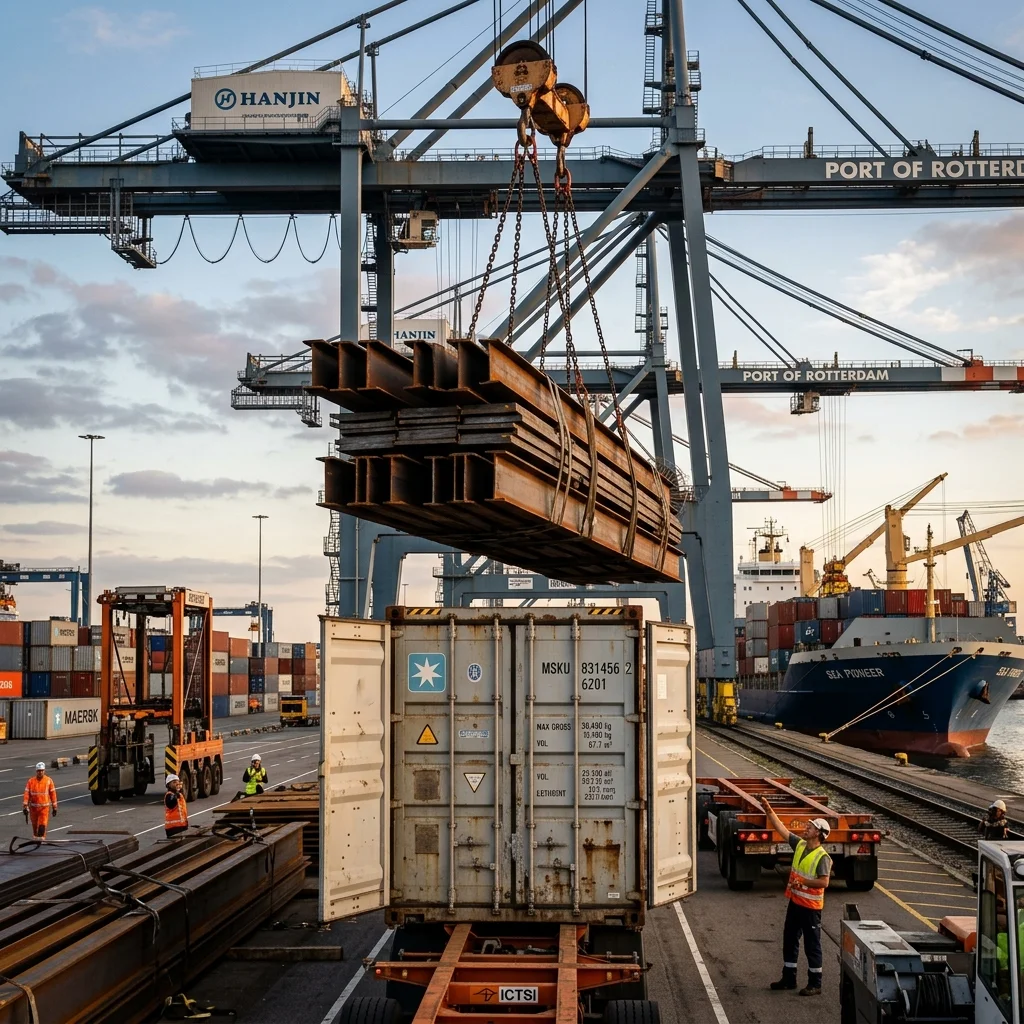
Strategic Payload Logistics and Cargo Containment: A Comprehensive Technical Guide to Volumetric Efficiency, Weight Distribution, and Regulatory Compliance
Strategic Payload Logistics and Cargo Containment: A Comprehensive Technical Guide to Volumetric Efficiency, Weight Distribution, and Regulatory Compliance
3. The Flat-Pack Stable Kit Case Study
To mathematically demonstrate the payload trap in an applied industrial context, the distribution of heavy flat-pack equine stable kits provides an exact, real-world model. DB Stable manufactures a standard 3×3 meter flat-pack unit comprising hot-dip galvanized steel frames, heavy base panels, and 2.4-meter-tall HDPE wall panels.
The primary metrics governing the shipment of these units are absolute:
- Cargo Mass: A single 3×3 meter kit weighs an average of 750 kilograms (within a 650 to 850 kilogram variance).
- Container Envelope: A 40HQ container provides 76 CBM of theoretical volume, an internal height of 2.69 meters, a door aperture height of 2.58 meters, and a maximum operational payload limit of approximately 26,000 kilograms.
When subjected to a generic volumetric calculation, the 76 CBM space implies that up to 32 standard stable kits could be loaded if the cargo were perfectly box-shaped. Alternatively, volume alone might falsely suggest a load of 12 conjoined heavy units, whereas payload realities dictate a hard stop at 10 or 11 units. When evaluating the standard 3x3 kits, calculating purely by the 26,000-kilogram payload limit against the 750-kilogram unit weight yields a theoretical maximum of 34 kits:
26,000 kg ÷ 750 kg = 34.6 Kits
However, neither 34 nor 32 units represent a viable logistical reality. The true constraint lies in the intersection of mass and geometric nesting logic. Steel frame bundles are nested into robust bundles that consume four vertical tiers, base panels are stacked flat up to 40 units deep, and the 2.4-meter-tall HDPE wall panels must be oriented vertically side-by-side to clear the 2.58-meter door and fit within the 2.69-meter internal height. Furthermore, the logistics planner must account for the requisite timber pallets and heavy-duty industrial strapping, which add an aggregate tare weight of approximately 1,500 kilograms to the cargo.
When evaluating both the rigid geometric nesting constraints and the actual payload limit, the safe, real-world capacity for a 40HQ is mathematically proven to be 28 to 30 units:
30 Kits × 750 kg = 22,500 kg (product)
Total Cargo Mass = 22,500 kg (product) + 1,500 kg (dunnage) = 24,000 kg
At 24,000 kilograms, the payload is optimal and highly efficient, resting safely below the 26,000-kilogram operational ceiling. Any supplier promising a buyer that 32 or more units can be consolidated into a single 40HQ container is either utilizing inferior, lighter materials or willfully ignoring the payload limits. For smaller orders, a typical load of 10 single 3×3 meter kits weighs only 7,500 kilograms, sitting well under the limit, while complex quadruple 3×6 meter units—which share roof sections—are typically limited to 4 or 5 units per 40HQ due to the difficulty of loading 6-meter roof panels lengthwise.
4. The Financial Annihilation of Margin
Falling into the payload trap generates a cascade of severe, compounding financial liabilities. If a distributor ignores the 26,000-kilogram ceiling and attempts to stuff the container based purely on spatial assumptions, the unit will violate its gross vehicle weight parameters.
Upon arrival at the port of origin, the overweight container will be immediately flagged by wharf weighbridges during the mandatory SOLAS VGM submission process. The container is subsequently immobilized, forcing the shipper to pay daily demurrage fees ranging from $200 to $400 per day while the cargo sits isolated at the terminal. To resolve the legal violation, the port authority will mandate physical stripping operations; the oversized load must be unpacked, and the surplus units split into a second container.
This action instantly doubles the logistics overhead. A standard ocean freight invoice from China to Australia, typically modeled at $5,500 to $6,000 in 2026, violently expands to $11,000. This unbudgeted penalty entirely erases the profit margin gained from negotiating a low factory price. Moreover, even minor, unrecognized 2% volumetric underfills occurring across a volume of shipments will ultimately force a buyer to pay for an entire "ghost container" over a fiscal year—an invisible, silent $6,000 capital write-off.
5. Structural Integrity: Point Loading and Floor Cross-Member Physics
While adhering to the macro-level payload limit is essential, the micro-level placement of that mass upon the container floor governs structural survival. A manufacturer's payload rating—such as a 28,000-kilogram capacity for a 20GP container—operates on the strict engineering assumption that the mass is homogeneously distributed across the entire internal surface area. Cargo with a high mass condensed into a small footprint, such as heavy machinery, industrial generators, or multi-ton steel coils, introduces the severe risk of point-loading failure.
ISO 668 Floor Ballast Capacities
The sub-floor of an ISO container consists of marine-grade plywood suspended over a framework of high-tensile steel cross members. The plywood itself lacks the structural integrity to support heavy selective loads; it functions merely as a bridge between the load-bearing steel spars. According to the ISO 668 standard, container floor ballast capacities are rigidly engineered and differ fundamentally based on the length of the unit:
- 20-foot container floor: Engineered to withstand a maximum selective load of 4.5 tonnes per linear meter.
- 40-foot container floor: Engineered to withstand a significantly lower load of only 3.0 tonnes per linear meter.
Because a 40-foot container must span a much longer distance between its structural corner castings, its mid-span flexibility is notably higher, resulting in a 33% reduction in its per-meter load tolerance compared to the more rigid 20-foot chassis.
Calculating Cross-Member Stress Dispersal
Logistics engineers employ a precise mechanical formula to determine if a concentrated load requires additional structural shoring, such as heavy timber beams, to safely transfer kinetic energy into the chassis. The exact number of steel cross members beneath the plywood floor can be determined through visual inspection by counting the rows of securing screws traversing the deck from the rear doors to the front bulkhead.
For a standard 20-foot container containing 18 cross members and a maximum allowable payload of 28 tonnes, the baseline capacity is calculated as:
Capacity per Cross Member = 28 tonnes / 18 members = 1.55 tonnes per member
If a heavy industry shipper intends to load a 5-tonne steel coil, depositing it directly onto the plywood floor will instantaneously exceed the 1.55-tonne threshold of a single cross member, fracturing the floor upon impact. To comply with engineering limits, the load must be mathematically distributed over at least four structural members:
5 tonnes ÷ 1.55 tonnes/member = 3.22 members (requires at least 4 members)
This necessitates the installation of longitudinal timber load-spreading beams that extend outward beneath the coil. These beams, however, must not project outward from underneath the cargo by more than one meter on either side. If this shoring configuration remains insufficient for ultra-dense freight, the shipment must be reclassified for transport on an open flatrack container.
Forklift Axle Restrictions (ISO 1496/1)
The physical operation of stuffing the container introduces dynamic, rolling weight hazards. According to the ISO standard 1496/1, an industrial forklift is only permitted to operate inside a shipping container if its physical dimensions and mass distribution prevent it from punching through the floorboards:
- The combined weight of the forklift and its carried load must never exceed 5,460 kilograms on the front axle.
- To ensure adequate weight displacement, the forklift tires must maintain a minimum contact surface area of 142 square centimeters per tire, possess a minimum width of 18 centimeters, and adhere to a track width distance of 76 centimeters between the wheels on a single axle.
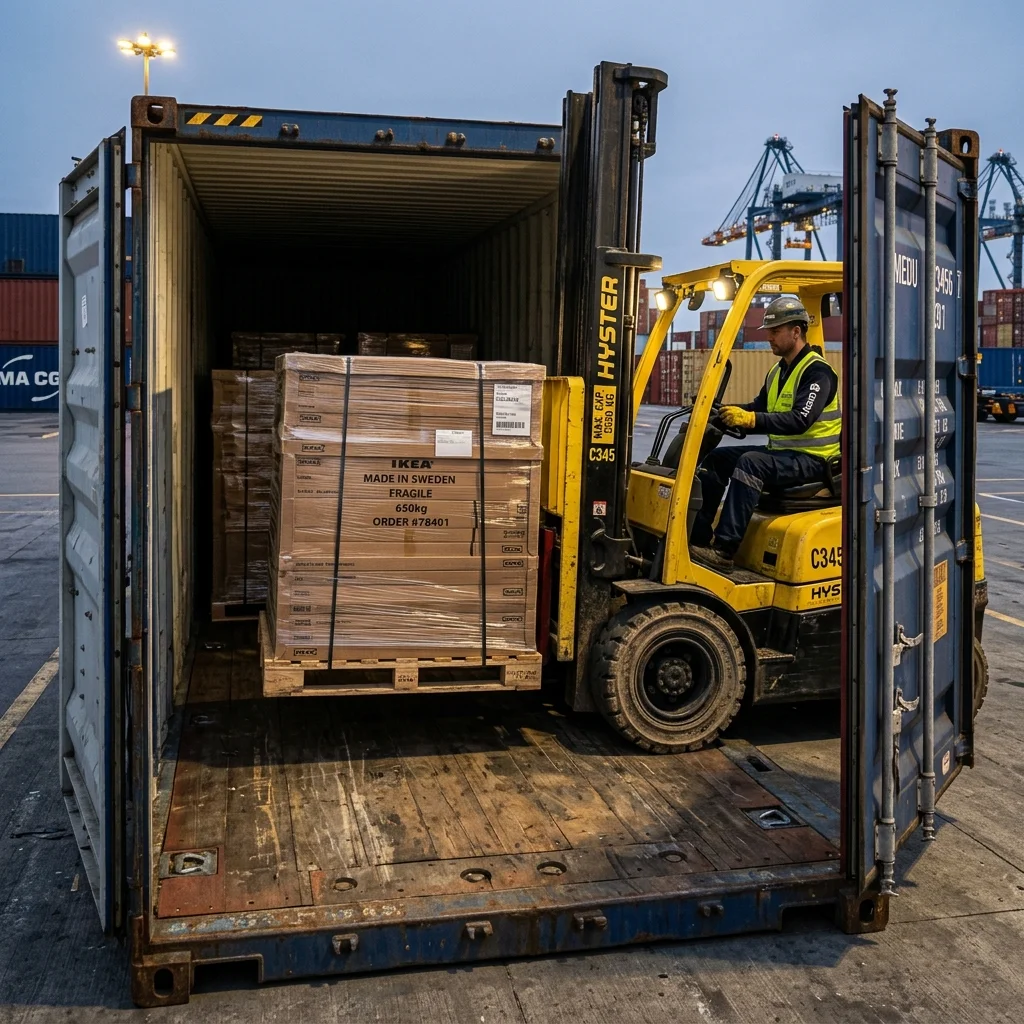
Strategic Payload Logistics and Cargo Containment: A Comprehensive Technical Guide to Volumetric Efficiency, Weight Distribution, and Regulatory Compliance
Strategic Payload Logistics and Cargo Containment: A Comprehensive Technical Guide to Volumetric Efficiency, Weight Distribution, and Regulatory Compliance
6. The CTU Code: Center of Gravity and Longitudinal Stability
Once the heavy cargo is safely supported by the floor members, it must be meticulously balanced to prevent catastrophic handling dynamics. The physics of container balance directly influence safety during crane operations, oceanic vessel transit, and high-speed terrestrial haulage. The IMO/ILO/UNECE Code of Practice for Packing of Cargo Transport Units (CTU Code) provides the definitive global regulatory framework for load distribution.
The ±5% Deviation and the 60/40 Distribution Rule
The CTU Code mandates that the aggregate center of gravity (CG) of the internal cargo must be positioned as close to the physical center of the container's geometric length and width as possible:
- The 5% Rule: The longitudinal center of gravity must not deviate off-center by more than ±5% of the total container length. For a 40-foot container, this translates to an extraordinarily strict tolerance of ±30 centimeters from the exact midpoint. For a 20-foot container, the allowable deviation is a mere ±15 centimeters. While deviations of up to ±10% may be tolerated under special circumstances where modern spreader cranes at tier-one ports can automatically compensate for the shift, subordinate regional ports lack this technology.
- The 60/40 Rule: As a secondary empirical safeguard, no more than 60% of the total cargo mass should be located within 50% of the container's length. When applying this rule, shippers must guarantee that the heavier 60% segment is not positioned hard against the front bulkhead, as this will critically overload the drive axle of the terrestrial tractor unit.
Port authorities enforce these tolerances with zero leniency. Inspectors will open containers, measure the physical distance from the rear doors to the cargo stack, and if an asymmetric load leaves a gap greater than 60 centimeters with inadequate load securing, the unit is immediately immobilized.
The Lever Principle and Center of Gravity Mathematics
For complex loads comprising multiple disparate pallets or industrial components, logistics planners determine the longitudinal location of the cargo's center of gravity using a weighted average calculation based on the lever principle:
Distance to Total Center of Gravity = ∑ (w_i × d_i) / ∑ w_i
For example, a highly asymmetric load comprising five distinct pallets might present the following profile:
- 700 kg × 0.40 m = 280 kgm
- 800 kg × 1.20 m = 960 kgm
- 900 kg × 2.00 m = 1,800 kgm
- 1,000 kg × 0.60 m = 600 kgm
- 1,100 kg × 1.60 m = 1,760 kgm
The total mass of the load is 4,500 kilograms, and the sum of the moments is 5,400 kgm. Dividing the total moment by the total mass (5,400 ÷ 4,500) reveals that the aggregate center of gravity resides exactly 1.20 meters from the end wall. By executing this mathematical validation prior to dispatch, shippers ensure the final center of mass falls strictly within the compliant 5% to 10% operational envelope.
7. The Terrestrial Bottleneck: Highway Gross Combination Mass
Perhaps the most devastating manifestation of the payload trap occurs when a perfectly legal, well-balanced ocean container makes landfall and transitions to inland road networks. There exists a severe regulatory disconnect between maritime engineering limits and civil highway infrastructure statutes.
A standard 40HQ container may boast an ISO maximum gross weight of 30,480 kilograms, equipped with a safe maritime payload of 26,000 kilograms. However, once that specific container is mounted onto a chassis and hitched to a tractor unit, the entire mechanical combination is subjected to Gross Vehicle Weight (GVW) or Gross Combination Mass (GCM) limits enforced by national and federal transport authorities to prevent the destruction of asphalt, bridges, and civilian safety.
The Arithmetic of European Haulage Weight Deductions
To calculate the true allowable payload for inland terrestrial haulage, an exporter cannot rely on the container's plated maximum; they must subtract the total equipment tare weight of the truck from the legal highway limit.
- Heavy Tractor Unit: ~8,500 kg
- Standard Container Chassis/Semi-Trailer: 4,500 kg to 5,600 kg
- 40-Foot Container Tare: ~3,900 kg
- Total Highway Dead Weight: ~16,900 kg
Permitted Terrestrial Payload = Legal Limit (40,000 kg) - Total Tare Weight (16,900 kg)
Permitted Terrestrial Payload = 23,100 kg
If an importer, relying solely on the 40HQ's ocean payload specification of 26,000 kilograms, loads the container to the brim with high-density steel components, the final road weight of the truck will hit 42,900 kilograms. This severely violates the 40-tonne EU directive limit. The shipment will be impounded at the port exit gates, forcing the logistics provider to initiate costly stripping operations to extract 2,900 kilograms of cargo before the vehicle is legally permitted to access the public highway.
Fragmented Global Regulatory Matrices
The payload trap is further complicated by intense regulatory fragmentation across global jurisdictions. Route planners must navigate a labyrinth of contradictory gross mass and axle weight laws:
| National Jurisdiction | Standard Gross Combination Limit | Intermodal / Specialized Allowances | Primary Regulatory Characteristics |
|---|---|---|---|
| United States | 80,000 lbs (36,287 kg) | Up to 90,000 lbs via state permits | The Federal Bridge Formula dictates axle spacing to protect infrastructure. Exceeding 44,000 lbs of cargo generally requires specialized heavyweight permits. |
| United Kingdom | 40,000 kg (Standard 5-axle) | 44,000 kg (6-axle configurations) | To transport a full 26,000 kg payload inside a 40-foot container, operators must deploy heavy-plated 6-axle combinations; otherwise, payloads are severely restricted. |
| Netherlands & Belgium | 40,000 kg (Cross-border) | 44,000 kg to 50,000 kg (National) | The Netherlands permits combinations up to 50 tonnes for localized national transport. Belgium enforces 44 tonnes strictly for 4+ axle setups, dropping to 26 tonnes for 3-axle vehicles. |
| Germany, France, Spain | 40,000 kg (Standard) | 44,000 kg (Combined Transport) | The 44-tonne limit is typically restricted to domestic transport allowances or highly regulated intermodal operations. |
| Sweden & Finland | 60,000 kg to 76,000 kg | European Modular Systems (EMS) | Among the most permissive globally, utilizing longer, heavier vehicles (up to 25.25 meters) to maximize long-distance efficiency in remote areas. |
Matrix compiled from federal transport directives, axle-load guidelines, and cross-border mass agreements.
Intermodal Harmonization and Zero-Emission Future-Proofing
To alleviate these terrestrial bottlenecks and prevent the 40-tonne limit from throttling global trade, European intermodal freight frameworks have sought to harmonize supply chains by permitting a 44-tonne maximum for combined transport operations involving ISO containers or swap bodies. At 44 tonnes, the payload mathematics shift into alignment with ocean engineering:
Permitted Payload = 44,000 kg - 16,900 kg = 27,100 kg
This vital allowance ensures that the full 26,000-kilogram capacity of a 40HQ container can be transported seamlessly from the port to a railhead or inland depot without legal friction.
Furthermore, as the logistics sector rapidly transitions toward decarbonization, critical amendments to the Weights and Dimensions Directive (WDD) are introducing strategic incentives for Zero-Emission Vehicles (ZEVs). A fully electric tractor unit houses heavy lithium-ion battery banks, which historically penalized transport operators by consuming massive portions of their allowable payload capacity. Under new regulatory provisions, ZEVs are granted an additional gross weight allowance of up to 4 tonnes, effectively elevating a 40-tonne baseline to 44 tonnes, or a 44-tonne limit to 48 tonnes. This progressive legislation ensures strict payload parity with traditional diesel vehicles. However, authorities clearly mandate that as battery chemistries evolve and become lighter over the next decade, transport operators are prohibited from repurposing these legacy weight savings to haul additional commercial cargo.
Axle Loading, Bridge Formulas, and Kingpin Dynamics
Gross weight compliance remains secondary to the microscopic physics of individual axle distribution. Exceeding national limits on a specific drive or trailer axle accelerates infrastructure degradation and induces fatal vehicle handling anomalies. Global transport authorities routinely enforce maximums of 10 to 11.5 tonnes on single drive axles, 18 to 20 tonnes on tandem configurations, and up to 24 tonnes for tri-axle trailer bogies. In the United States, compliance is governed by the Federal Bridge Formula, which mathematically scales the permitted gross weight directly against the longitudinal distance between the axles, forcing carriers handling dense freight to invest in extended, multi-axle specialized chassis.
If a 40-foot container is loaded without strict adherence to the CTU 60/40 rule, the consequences on the road are immediate. Should 70% of the dense cargo mass be consolidated near the front bulkhead, the tractor's fifth wheel (the kingpin hitch) absorbs a massive kinetic overload. This dynamic force transfers directly to the tractor's rear drive axle, instantly pushing it beyond the 11.5-tonne legal limit. The result is a severe regulatory violation, regardless of whether the total combination mass remains well under the 40-tonne maximum. Conversely, locating the bulk of the mass against the rear container doors acts as a massive pendulum, lifting the tractor's front steering wheels off the pavement and resulting in catastrophic loss of directional control and braking efficiency.
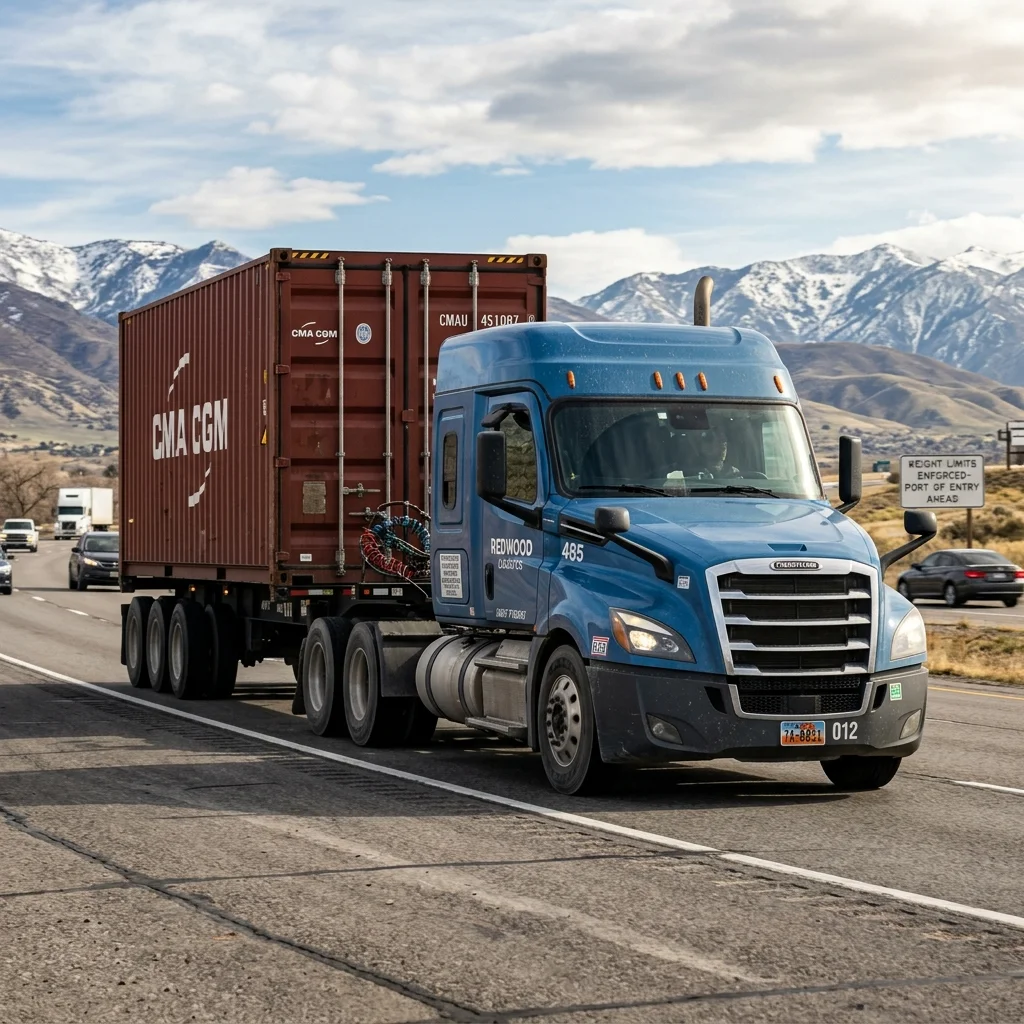
Strategic Payload Logistics and Cargo Containment: A Comprehensive Technical Guide to Volumetric Efficiency, Weight Distribution, and Regulatory Compliance
Strategic Payload Logistics and Cargo Containment: A Comprehensive Technical Guide to Volumetric Efficiency, Weight Distribution, and Regulatory Compliance
8. The Last-Mile Payload Trap: Light Commercial Fleets and Towing Dynamics
The mechanical logic governing deep-sea containers translates perfectly to the final phase of the supply chain: last-mile delivery, light commercial trade fleets, and specialized heavy towing. Fleet managers utilizing commercial utilities (such as the Toyota Hilux or Ford Ranger) or towing massive twin-axle equipment must navigate a highly concentrated version of the payload trap.
GVM, GCM, and the Accessory Drain
Just as a container's tare weight erodes its payload, a commercial vehicle's available capacity is dictated by its Mass in Running Order (MRO) or Kerb Weight, matched against its Gross Vehicle Mass (GVM) and Gross Combination Mass (GCM):
- GVM: The absolute maximum legal weight of the fully loaded vehicle, including passengers, fuel, aftermarket accessories, and cargo.
- GCM: The combined maximum allowable weight of the loaded vehicle and a fully loaded trailer.
The light commercial payload trap frequently catches fleet managers who overbuild their vehicles. For instance, the installation of a heavy-duty steel canopy (100 kg), a modular drawer system (80 kg), and roof racks rapidly consumes the vehicle's functional payload before any commercial tools or materials are loaded. Substituting a steel canopy for a powder-coated aluminum alternative (40–70 kg) immediately recaptures 30 to 50 kilograms of payload, ensuring the vehicle remains legally compliant on public roads without exceeding the GVM limit.
Tow Ball Mass (TBM) and the Stability Paradox
When fleet vehicles are required to tow heavy plant equipment or luxury twin-axle caravans, the physics of weight distribution become highly volatile. Twin-axle configurations feature a broader footprint that minimizes side-wind snaking, generating a false sense of security—a phenomenon known as the twin-axle stability paradox. Despite feeling firmly planted on the road, heavy trailers impose immense downward force on the vehicle's hitch, known as Tow Ball Mass (TBM).
A safe TBM must generally remain between 8% and 15% of the trailer's total weight. If the TBM is too light (under 8%), the trailer acts as a rearward pendulum, inducing violent trailer sway. If the TBM exceeds 15%, the excessive downward force overloads the tow vehicle's rear suspension, acting as a seesaw that lifts the front steering axle off the road.
Crucially, the exact weight of the TBM is legally absorbed into the tow vehicle's GVM. If a popular dual-cab utility vehicle possesses a kerb weight of 2,200 kg and a GVM of 3,200 kg, its theoretical payload is 1,000 kg. However, adding four adults (320 kg), a heavy steel canopy and bull bar (200 kg), and basic gear (150 kg) consumes 670 kg of that payload. If the vehicle then hitches a 3,000-kilogram trailer projecting a 10% TBM, an additional 300 kilograms of mass is instantly applied to the vehicle's rear axle. The total vehicle payload becomes 970 kg, leaving a dangerously slim 30-kilogram margin of safety before the entire combination violates its GVM and voids corporate fleet insurance. Additionally, standard equipment such as quad-motor movers—essential for maneuvering heavy 2,000+ kilogram twin-axle units on industrial tarmac—add an unyielding 60 to 80 kilograms of dead weight directly to the trailer's payload, further constricting capacity.
9. Algorithmic Load Planning: Digital Twin Simulations
Because legacy volume calculators treat complex global logistics as basic primary-school arithmetic, elite industrial shippers have transitioned entirely to advanced 3D Cargo Load Calculators to preemptively neutralize the payload trap. Digital twin load simulation platforms operate natively in web-browser environments, allowing freight forwarders and export planners to generate mathematically validated, three-dimensional loading protocols without relying on estimation. Instead of treating a 76 CBM container as an empty, theoretical void, these systems execute strict, multi-variable parameter validation:
- Precision Profiling:
The software imports the precise internal dimensions and specific maximum payload capabilities of the selected ISO container, instantly establishing the dual volumetric and mass boundary. - Geometric Cargo Definition:
Planners input exact dimensional data alongside strict rotational parameters. The algorithm mathematically comprehends that a 2.4-meter HDPE panel must remain vertically oriented, or that a liquid chemical drum cannot be inverted for the sake of spatial efficiency. - Packaging Overheads:
The system dynamically accommodates custom pallet definitions and automatically deducts the structural tare weight of the pallet from the total usable payload capacity. - Shrinkage & Tolerances:
Planners can apply a 5% volumetric "shrinkage" margin to simulate real-world physical tolerances, acknowledging that industrial cardboard bulges, dunnage bags consume space, and human forklift operators require safe physical clearance room. - Center of Gravity Automation:
As the artificial intelligence nests the virtual cargo, it continuously recalculates the longitudinal and lateral center of gravity, guaranteeing that the final output strictly adheres to the CTU Code's ±5% geometric rule.
The resulting digital output is a comprehensive, step-by-step 3D PDF loading plan that dictates exactly how forklift operators must build the stack on the warehouse floor. By shifting spatial optimization from the chaotic loading dock into the digital realm, suppliers can guarantee buyers that an exact, verified number of complex units—such as a rigid cap of 30 DB Stable flat-packs—will fit seamlessly. This methodology routinely achieves an optimal 92% volume utilization while remaining perfectly compliant with both deep-sea payload regulations and terrestrial highway axle limits.
10. Strategic Documentation Mapping
Beyond physics and geometry, 3D simulation accommodates vital bureaucratic workflows. Heavy cross-border industrial shipments often face rigorous biosecurity and customs interventions (such as Australia's strict DAFF regulations). Digital loading models allow planners to designate precise, highly visible zones immediately inside the container's rear doors for mandatory legal documentation, including critical timber fumigation certificates. Ensuring rapid, frictionless access to this paperwork upon arrival prevents border forces from initiating highly destructive, invasive physical unpacks, which routinely generate 3 to 5-day holdups and incur thousands of dollars in unavoidable demurrage fees.
11. Strategic Synthesis and Logistics Equilibrium
The contemporary global supply chain operates with zero tolerance for theoretical estimation. As international maritime shipping rates fluctuate wildly, digital e-commerce volumes surge into the 2026 fiscal year, and regulatory scrutiny tightens relentlessly across European, North American, and Asian road networks, the operational margin for "guessing" container loads has evaporated.
The persistence of the payload trap demonstrates that treating physical mass and internal volume as isolated variables will inevitably lead to structural compromise and financial hemorrhage. To secure freight margins and ensure absolute global compliance, industrial operators must adopt a rigorous synthesis of data:
- Acknowledge the Dual Constraint: Total cargo capacity is absolutely determined by whichever operational threshold—internal volume or maximum payload—is breached first.
- Reverse-Engineer from the Destination: Deep-sea maximums of 30,480 kilograms are irrelevant if the final destination jurisdiction strictly enforces a 40-tonne Gross Combination Mass on its highways, thereby limiting the real-world container payload to just 23,100 kilograms.
- Respect Structural Physics: Container floor ballast thresholds (3.0 to 4.5 tonnes per meter), the CTU Code's 60/40 mass distribution rule, and rigid ±5% center-of-gravity tolerances are non-negotiable mechanical realities, not mere suggestions.
- Digitize the Architecture: Logistics teams must discard elementary volume calculators in favor of exact 3D geometric nesting simulations that account for component density, rotational limitations, and the compounding tare weights of pallets and fleet vehicles.
By aligning advanced digital load planning with a profound regulatory command of international transport directives, procurement teams and logistics operators can maximize the efficiency of every cubic meter, circumvent the payload trap entirely, and guarantee frictionless transit from the factory floor to the final terrestrial destination.