

In the fields of civil, environmental, and industrial engineering, securing reliable containment barriers is crucial to protecting both natural ecosystems and industrial investments. While High-Density Polyethylene (HDPE) remains the standard for rigid structures, highly challenging environments with irregular terrain, shifting soils, or landfill subsidence require a containment solution that possesses exceptional elasticity and conformance. Linear Low-Density Polyethylene (LLDPE) geomembranes provide the ultimate balance of high chemical resistance, excellent puncture protection, and unmatched mechanical flexibility.
Engineered specifically to accommodate structural shifts and differential settlement, LLDPE liners are widely utilized in municipal solid waste caps, mining tailing covers, decorative ponds, and hazardous liquid secondary containments. This detailed engineering guide explores LLDPE material science, the definitive GRI-GM17 standard, smooth vs. textured options, and site-level installation and quality assurance protocols.
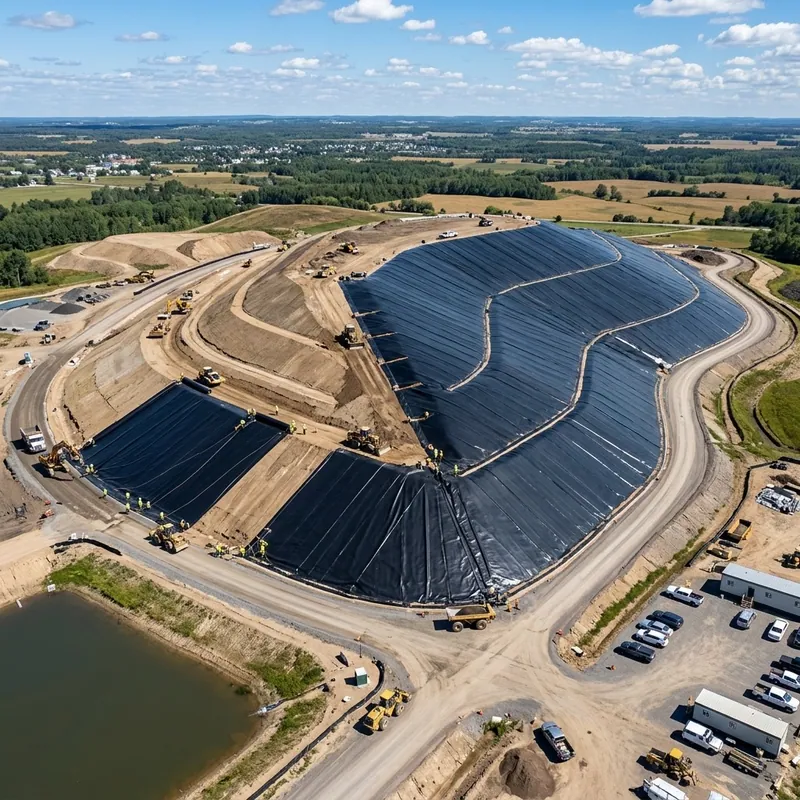
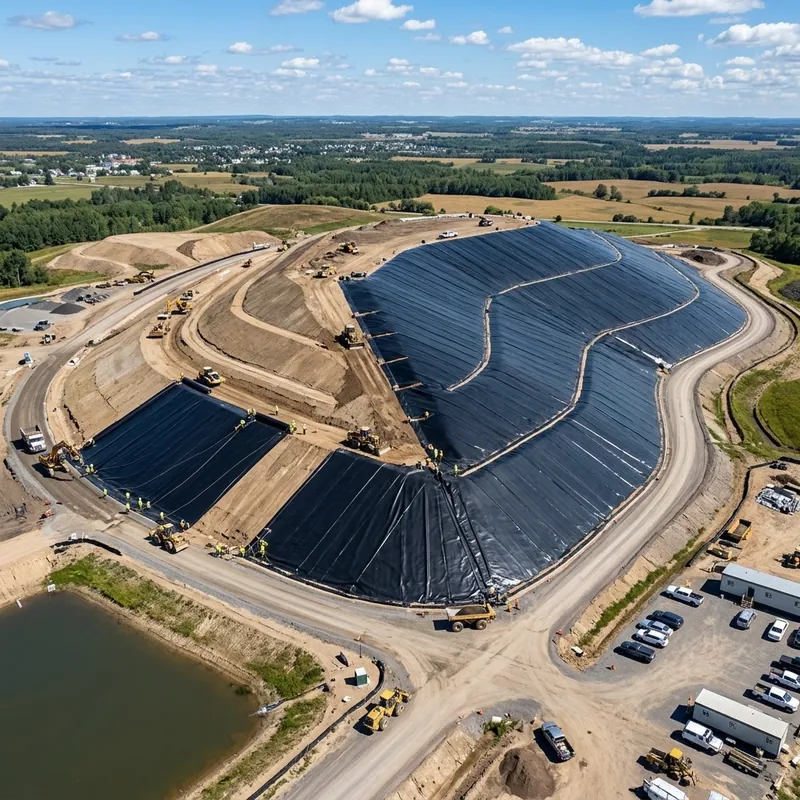
Massive landfill capping and sealing project using LLDPE geomembrane covers
Figure 1. Large-scale landfill cap installation utilizing highly flexible LLDPE sheets to accommodate long-term waste settlement.
The Polymer Chemistry and Mechanical Behavior of LLDPE
Understanding the unique benefits of LLDPE requires looking at its molecular architecture. LLDPE is synthesized through the copolymerization of ethylene with longer-chain alpha-olefins (such as butene, hexene, or octene) under low pressure and temperature. This process creates a polymer backbone with short, uniform branching along the chains.
Unlike traditional Low-Density Polyethylene (LDPE) which features highly branched, irregular structures, LLDPE’s short-chain branching allows the polymer chains to slide past each other smoothly upon elongation, giving the material its signature mechanical flexibility. This molecular layout provides LLDPE geomembranes with over 800% elongation at break, extraordinary multi-axial elongation capacity, and superior resistance to Environmental Stress Cracking (ESCR).
🧬
High Elongation
Boasting over 800% tensile elongation, LLDPE easily conforms to uneven subgrades and tolerates significant differential settlement without rupture.
☀️
UV & Aging Stability
Incorporation of 2.0% to 3.0% finely dispersed carbon black protects LLDPE liners from ultraviolet degradation and oxidative aging during prolonged exposure.
❄️
Stress Crack Immunity
LLDPE’s short-chain branching renders it virtually immune to stress cracking under localized pressure spikes and complex structural loads.
Smooth vs. Textured LLDPE: Selecting the Optimal Surface Profile
Surface selection for LLDPE geomembranes is an essential engineering decision based on friction requirements, slope angles, and structural safety parameters. LLDPE geomembranes are manufactured in two primary surface finishes: Smooth and Textured (Single or Double-Sided).
⚙️ Critical Functional Comparisons
Smooth LLDPE Liners
Excellent hydraulic flow properties make smooth liners ideal for flat lagoon beds, containment ponds, floating covers, and decorative lakes. They are cost-effective and highly reliable for non-sloped applications.
Textured LLDPE Liners
Featuring engineered asperities, textured LLDPE maximizes interface friction with soil, sand, and geotextiles. Uniquely suited for steep side slopes, landfill caps, and industrial mine heap leach covers where slippage is a risk.
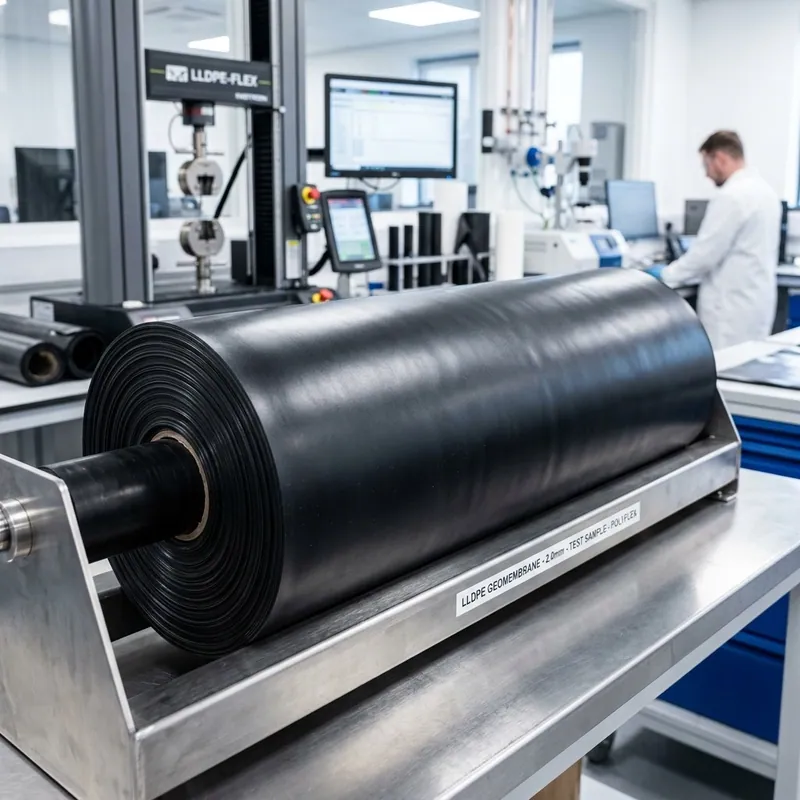
Quality control of smooth, puncture-resistant black LLDPE geomembrane rolls
Figure 2. Precision LLDPE geomembrane roll under strict factory inspection, confirming thickness uniformity and surface consistency.
Primary Applications: Where Elasticity and Toughness Matter
Due to its superior elongation, tear strength, and flexible profile, LLDPE geomembranes serve as the standard barrier in projects where other polymers would fail under structural strain.
Core Engineering Fields
- 💧
Flexible Water Reservoirs: Accommodates thermal expansion and shifting soil levels in hot and cold arid climates. - 🗑️
Landfill Caps: Conforms to landfill settlement and gas pockets, preventing rainwater infiltration. - ⚙️
Secondary Containment: Underlays chemical processing pads and oil tank farms to prevent soil contamination. - ⛏️
Mining Slag Ponds: Offers containment under heavy heap-leach operations and tailing stacks.
Standard Liner Thicknesses
Water & Aquaculture Ponds
0.50 mm - 0.75 mm
Irrigation & Canal Liners
0.75 mm - 1.00 mm
Landfill Caps & Covers
1.00 mm - 1.50 mm
Secondary Heap-Leach & Mining
1.50 mm - 2.00+ mm
Technical Specifications and GRI-GM17 Quality Standards
Procuring top-tier LLDPE liners requires verification against the global GRI-GM17 standard developed by the Geosynthetic Research Institute. This standard specifies rigorous limits on physical, mechanical, and longevity criteria using specific ASTM test methods.
| Physical Property | ASTM Test Method | GRI-GM17 Standard Requirement |
|---|---|---|
| Nominal Thickness | ASTM D5199 | Maximum negative tolerance of 10% from nominal value. |
| Formulated Density | ASTM D1505 | Must be ≤ 0.939 g/ml for linear low-density classification. |
| Tensile Behavior (Elongation) | ASTM D6693 | Minimum break elongation of 800% to ensure high structural flexibility. |
| Puncture Resistance | ASTM D4833 | Excellent point-load protection against stones and uneven subgrade elements. |
| Tear Resistance | ASTM D1004 | High tear initiation resistance to prevent wind damage during construction. |
| Carbon Black Content | ASTM D4218 | Strictly controlled between 2.0% and 3.0% for optimal UV protection. |
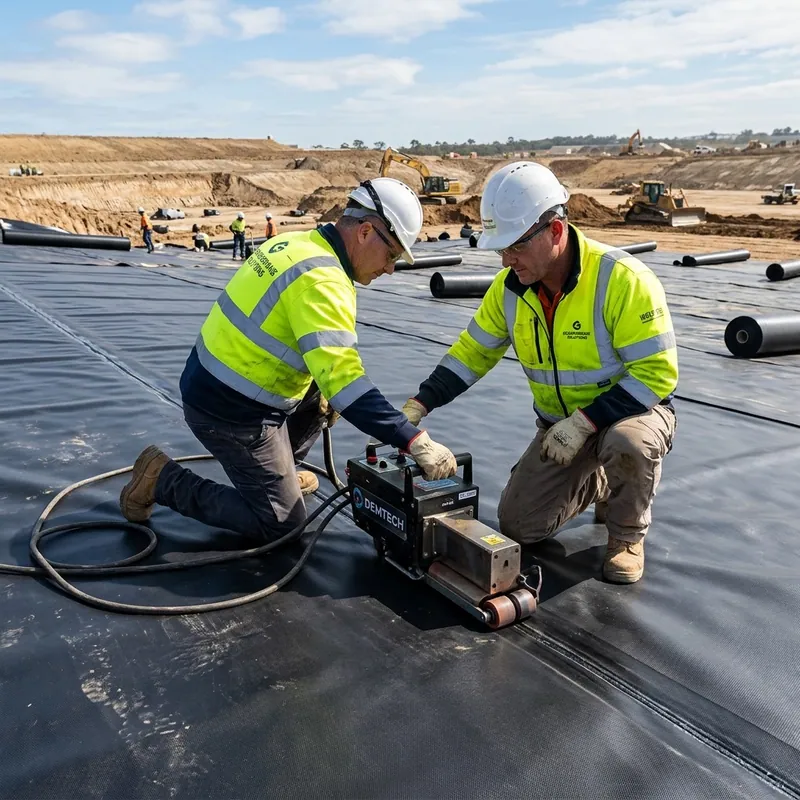
Precision double hot-wedge seam welding of LLDPE geomembrane rolls
Figure 3. On-site hot wedge welding process showing precise overlap and formation of a testable dual-track seam.
Field Installation Protocols & Quality Assurance (CQA)
Ensuring absolute containment integrity relies heavily on site preparation, hot wedge or extrusion welding parameter settings, and thorough testing. LLDPE requires distinct field practices due to its higher thermal expansion coefficient and flexible properties.
Thermal Control & Symmetrical Anchoring
LLDPE is highly sensitive to ambient temperature changes. Installing the liner too tight during the hot afternoon can cause stress cracks or anchor pullout when it contracts at night. Installers must lay LLDPE with a minor wave profile to allow safe movement under varying temperatures.
Dual-Track Hot Wedge Seam Welding
Continuous seams are formed using automated dual-track hot wedge welders. A heated bronze wedge melts the overlapping LLDPE edges, and pressure rollers fuse them. This creates a high-strength bond with a central air channel that is used for non-destructive pressure testing.
Non-Destructive Testing (NDT)
All fused seams are verified for structural integrity. The Air Channel Test (ASTM D5820) inflates the central weld void to 2.0 bar pressure and monitors for pressure loss over 5 minutes. Hand-welded patches are tested using the Vacuum Box Chamber (ASTM D5641) under soapy water to identify minor air bubbles.
Eco-friendly floating covers and wastewater treatment lagoons lined with LLDPE
Figure 4. Sustainable, flexible industrial wastewater treatment lagoon utilizing LLDPE geomembranes for high chemical protection.
Environmental Longevity & Sustainable Performance
Beyond providing a strong physical barrier, LLDPE geomembranes act as highly effective tools for ecological preservation, water conservation, and clean-energy infrastructure.
Water Retention: In arid and desert climates, lining unpaved earth reservoirs with LLDPE eliminates up to 45% of water losses caused by soil absorption.
Groundwater Protection: In municipal solid waste management, LLDPE caps prevent clean rainwater from entering the waste layer, blocking the formation of hazardous leachate.
Inert Composition: LLDPE features an inert chemical design containing zero migrating plasticizers, ensuring it won't leach toxins into soil or groundwater over its 100+ year service life.
Five Engineering Pitfalls in LLDPE Geomembrane Installation
1. Disregarding Site Thermal Fluctuations
Installing LLDPE sheets tightly in high afternoon heat causes excessive stress during cold night contraction, leading to bridging, seam tears, or anchorage failure. Ensure the liner is laid with minor wave slack.
2. Inadequate Subgrade Preparation
Failing to remove jagged stones, roots, and sharp protrusions from the base layer can puncture the geomembrane over time. Subgrades must be rolled and protected with a heavy cushion geotextile.
3. Overlooking Non-Destructive Weld Verification
Relying solely on visual checks instead of systematic air channel and vacuum box tests leaves hidden micro-holes undetected, leading to subsurface leaks that weaken the foundation.
4. Using Recycled Low-Grade Resins
Low-grade liners made from recycled scraps degrade quickly under UV rays. Demanding GRI-GM17 compliant sheets made from 100% virgin polymer is critical to ensuring long-term durability.
5. Deploying Smooth Liners on High Steep Slopes
Using smooth geomembranes on steep embankments reduces soil interface friction, causing capping soils or covers to slip down. Textured LLDPE must always be specified for steep slopes.
Frequently Asked Questions
What is the typical service life of an LLDPE geomembrane?
+
When buried under soil or protective layers (e.g., in landfill caps), LLDPE geomembranes conforming to the GRI-GM17 standard can last over 100 to 200 years. If left exposed to continuous direct UV radiation, their typical service life ranges between 20 to 30 years.
How does LLDPE differ mechanically from HDPE geomembranes?
+
HDPE is highly rigid, offering higher chemical resistance and tensile yield strength, which is ideal for flat, stable basins. LLDPE is significantly more flexible, providing higher elongation (≥800%) and tear resistance, making it perfect for areas prone to settlement and irregular shapes.
What does GRI-GM17 compliance indicate?
+
GRI-GM17 is the definitive quality specification developed by the Geosynthetic Research Institute. It guarantees that LLDPE liners meet strict industrial benchmarks for thickness, density, tensile strength, tear limit, puncture load, and UV resistance.
Can LLDPE geomembranes be welded directly to HDPE?
+
Yes, because both HDPE and LLDPE belong to the polyethylene family. They can be thermally welded using dual-track hot wedge or extrusion welding machines, provided the technician carefully adjusts temperature and pressure parameters.
SherkatTrade: Your Global Partner for Advanced Geosynthetics
Designing and installing secure geosynthetic barriers requires a rigorous approach to material selection, technical calculations, and professional quality control. Choosing the right surface profile and thickness is key to ensuring long-term containment success.
At SherkatTrade, we leverage state-of-the-art polymer processing systems to manufacture premium LLDPE geomembranes that fully conform to the international GRI-GM17 and ASTM quality standards. Our flexible containment barriers successfully support large-scale water, mining, agricultural, and environmental protection projects worldwide.
Our dedicated engineering division is ready to assist you in designing the optimal lining solution and ensuring flawless installation on your job site.
Elevate Your Engineering Projects Today
Get in touch with us to receive technical datasheets, request pricing, or schedule a free consultation with our containment specialists.